
Mental Health Minutes: 200 Mental Health Topics Designed to Promote Psychological and Cognitive Wellness is available for purchase via Universal Publishers, Amazon, and Barnes & Noble
Mental Health Minutes offers a comprehensive look at 200 mental health topics designed to promote peak psychological and cognitive wellness in students, professionals, and mental health enthusiasts.
Each topic, presented in one page or less, includes clinical and historical examples, research studies, and personal anecdotes from the author. Key themes include the diagnosis and treatment of mental health disorders, strategies for optimizing mental and neurological well-being, personality traits and interpersonal skills, common human emotions and how to recognize them, as well as introductory concepts in neuroscience and the remarkable capabilities of the human brain.
The book is ideal for those seeking a broad overview of psychological and neuroscience topics, along with evidence-based strategies for enhancing mental health. Its accessible format also makes it a valuable resource for reviewing key concepts repeatedly after the initial read.
Mental Health Minutes is the result of extensive research conducted by Dr. Shanok while treating patients with various conditions, including major depressive disorder, post-traumatic stress disorder, and Alzheimer’s disease. He has also worked with athletes and professionals to help them achieve peak cognitive and psychological performance. His goal is to provide clients with the most accurate and up-to-date information, and with this book, make it accessible to anyone with a passion for mental health or helping others.
REVIEWS and WORDS OF PRAISE
“Our mental health profoundly shapes the way we perceive the world and experience life. Prioritizing our well-being not only enriches our thoughts but also enhances our daily human interactions, paving the way for a more fulfilling existence. For this reason, I strongly recommend investing the time in yourself to read this book and incorporate into your life the wisdom and lessons within its pages.”
—Raul J. Rodriguez, MD (Founder of the Delray Center for Healing)
“Dr. Nate Shanok’s latest publication is an insightful and comprehensive guide that addresses crucial aspects of mental health. Dr. Shanok’s passion for understanding the human mind is evident in each lesson, offering readers practical strategies for enhancing well-being. His dedication to promoting mental health awareness is both inspiring and commendable. This book serves as a valuable resource for anyone seeking to improve their psychological resilience and knowledge.”
—Marlene Sotelo, BCBA-D (Executive Director of Els For Autism Foundation)
“This book will be strongly recommended to each of my patients.”
—Danesh. A. Alam, MD (Clinical Assistant Professor at Northwestern University)
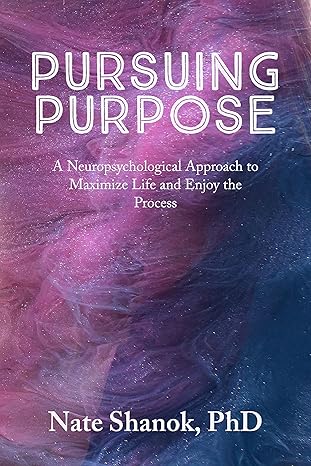
Pursuing Purpose: A Neuropsychological Approach to Maximize Life and Enjoy the Process is available for purchase on Amazon
Have you ever thought about your deeper purpose in life?
Are you currently on the right path or are you feeling lost in your existence?
Regardless of where you currently stand the lessons in this book can help you to:
- Identify your core purpose(s) in life to feel as though you are working towards your destiny.
- Implement evidence-based practices for maximizing your potential on a daily basis.
- Discover cutting-edge neuropsychological treatments for combatting depression and existential crisis.
Research over the past century has shown that perceiving purpose in one’s life is vital for mental and physical health.
Higher levels of purpose are related to reduced depression and anxiety, better quality of life, and lower risk for stroke and Alzheimer’s disease.
The author of this book dealt with an existential crisis and lack of purpose before discovering the work of Dr. Viktor E. Frankl and going on to become a neuropsychologist. Pursuing Purpose provides a method for using modern neuropsychology tools as well as the teachings of Dr. Frankl to maximize purpose and live life to the fullest.
Praise for Pursuing Purpose:
“The reader feels as though they are having a discussion with a trusted clinician who makes appropriate and helpful recommendations for discovering meaning and purpose. Even when discussing complicated subjects related to brain functioning or specific research studies, it is told in a way that is digestible to readers who do not have advanced degrees in neuropsychology.” —Viktor Frankl Institute of Logotherapy
“A highly thorough and helpful approach.”
—Alex Korb, Bestselling Author of The Upward Spiral
“It is absolutely worth it! Pursuing Purpose by Nate Shanok is a truly insightful read for those looking to get the most out of their lives. The book merges neuroscience, psychology, and practical advice to help readers understand their own potential and take action to achieve their desired life goals.” —Dr. Sukanlaya Sawang (Editor of Behavioral Sciences)
“Victor Frankl’s ideas about people’s search for purpose and meaning in life has been the bulwark for humanistic theory and psychotherapy. Rarely has it been examined from a neuropsychological perspective. This is what Nate Shanok has done in his highly accessible book, Pursuing Purpose: A Neuropsychological Approach to Maximize Life and Enjoy the
Process. Dr. Shanok takes the reader on a personal journey of discovering purpose and its role in psychological wellbeing. Shanok combines descriptions of his own quest for purpose and those of others with rigorous scientific evaluations of the importance of purpose and meaning in psychological adjustment. The novel contribution of this book is the successful integration of humanistic theory and therapy influenced by Frankl’s revolutionary ideas with solid empirical evidence, much of it neuropsychological. Pursuing Purpose will be of interest to anyone who has thought about the meaning of life (and whom of us hasn’t) but who wants the answers to this existential question to be based on solid science.”
—Dr. David Bjorklund (Author of Origins of the Social Mind: Evolutionary Psychology and Child Development and Editor of the Journal of Experimental Child Psychology)
 Nate Shanok, PhD
Leave a comment